
1. CLARITY
Say exactly what you want students to do. Students shouldn't have to translate vague expectations into behavior.
FOR ELEMENTARY TEACHERS
Your most powerful classroom management tool may be your voice.
Learn 10 simple language shifts that help students understand
directions, respond to correction, and follow through—without yelling, lecturing, or repeating yourself all day.
Free instant download. Plus, I'll send you more Teacher Voice strategies for creating a calmer, more responsive classroom.
Your Teacher Voice isn't a stern voice. It isn't yelling. And it isn't a special voice teachers suddenly develop when the classroom gets loud.
Your Teacher Voice is the intentional use of your:
💬 WORDS 🔊 TONE ◷ TIMING ? QUESTIONS Ⅱ PAUSES ● PRESENCE
to move students toward a desired action, behavior, or response.
And just like any other professional skill...It can be learned.
Inside my work on Teacher Voice, I focus on six communication skills.
Say exactly what you want students to do. Students shouldn't have to translate vague expectations into behavior.
Say less. Make your words matter more. Not every correction needs a lecture.
Be firm without becoming angry. Authority isn't volume.
Lower resistance without lowering expectations. Listening to students doesn't mean giving in to them.
Correct behavior without attacking identity. Make the expected behavior clearer without making the child feel smaller.
Don't let a dysregulated student choose your communication style for you. Your calm matters too.
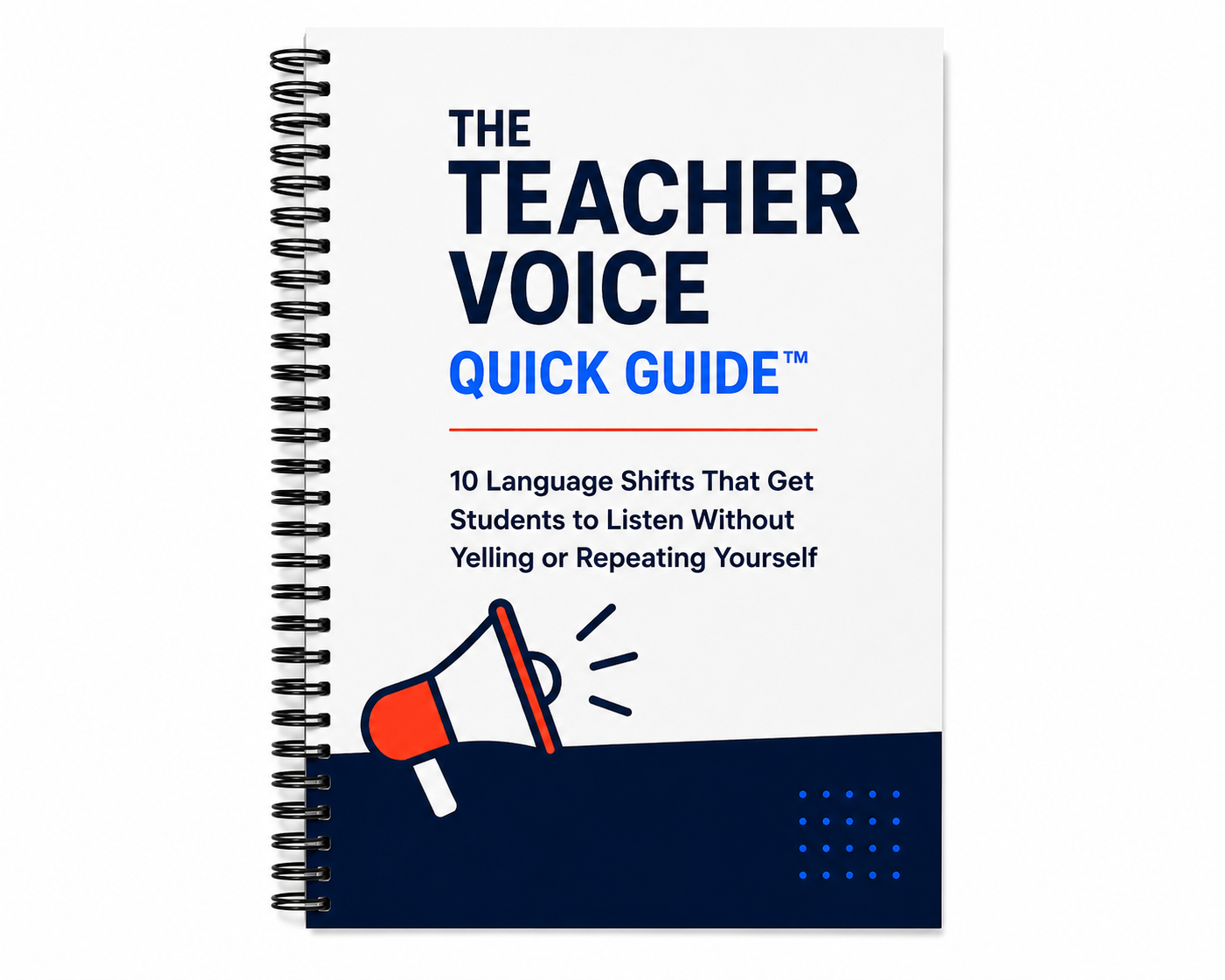
Inside this free guide, you'll discover 10 simple language shifts you can start using immediately to:
✓Get students' attention without raising your voice
✓Give directions that are easier to follow
✓Redirect behavior without power struggles
✓Handle refusal with less frustration
✓Transition your class with more ease
✓Build more respectful, responsive classrooms
Small shifts, Big impact.
Your words shape your classroom.
GET THE FREE TEACHER VOICE GUIDEYou'll get the "Instead of this → Try this" language AND the reason the new language works.
✓A teacher isn't communicating with two or three people.
✓You're moving an entire group.
✓You're communicating expectations while monitoring behavior.
✓You're correcting one student without losing the other twenty.
✓You're deciding when to speak, what to say, how much to say, and when to stop talking.
That's a professional communication skill.
And yet, many teachers have never been explicitly taught how to develop it. That's what I'm working to change.

Hey, I'm Michael.
I'm an elementary school counselor who has spent years working directly with students and teachers around behavior, communication, relationships, classroom structure, and social-emotional skills.
And one thing I keep seeing is this:
They can escalate resistance—or lower it.
They can create dependence—or teach responsibility.
They can turn a correction into a power struggle—or help a student understand exactly what needs to change.
Start with the tool you're already using hundreds of times every day.
Get The Teacher Voice Quick Guide™ and start changing the way students hear your directions, corrections, and boundaries tomorrow.
It's completely free.
Helping elementary teachers create calm, structured classrooms where students know what to do, follow through, and become increasingly independent.
Free instant download. Plus, I'll send you more Teacher Voice strategies for creating a calmer, more responsive classroom.